SPV Wallet, Explained
Simplified Payment Verification lets a wallet confirm transactions using block headers — not the full blockchain. It's how most lightweight wallets work, and it's why Dogechain Wallet syncs in minutes instead of days.
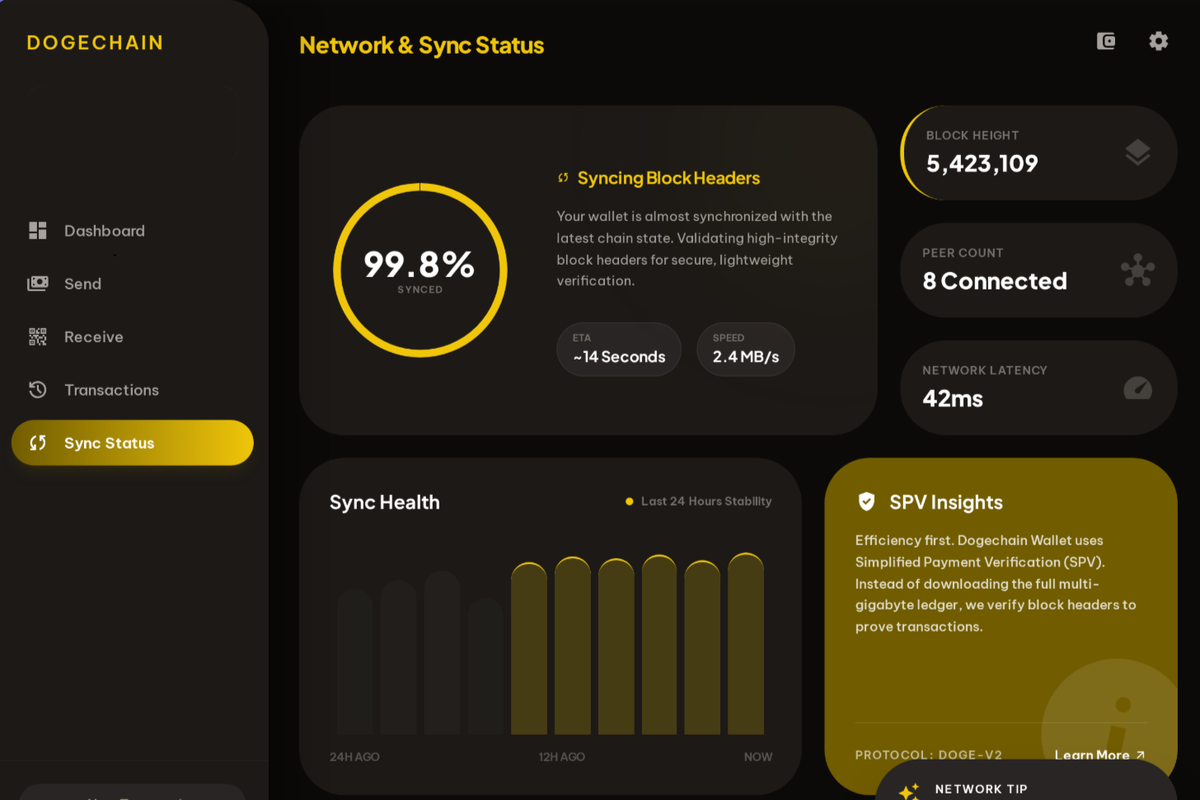
What SPV Means
SPV stands for Simplified Payment Verification. It was defined in section 8 of the original Bitcoin whitepaper as a way to let lightweight clients verify payments without running a full node.
Instead of downloading every transaction in the chain's history, an SPV client downloads only block headers — fixed-size 80-byte summaries — and uses Merkle proofs to confirm that a specific transaction was included in a specific block.
How an SPV Wallet Verifies a Transaction
Step 1: Connect to one or more network peers.
Step 2: Download the chain of block headers and verify the proof-of-work links between them.
Step 3: Request a Merkle proof for any transaction the wallet cares about.
Step 4: Confirm the transaction's hash is part of the Merkle tree committed to inside a header you trust.
The result is a cryptographic guarantee that the transaction is in a block the network accepted — without ever storing that block's full contents.
Trade-offs vs a Full Node
A full node independently validates every transaction against consensus rules. An SPV client trusts that network peers enforce those rules and only verifies inclusion. In practice, this is a strong guarantee because attempting to feed an SPV client invalid data requires forging proof-of-work — which is economically infeasible at Dogecoin's hash rate.
The trade-off is a smaller trust surface for the user (your device and your peers) in exchange for dramatically faster setup, lower storage, and lower bandwidth.
SPV in Dogechain Wallet
Dogechain Wallet is an SPV desktop client for Dogecoin. It uses the Dogecoin Foundation's Libdogecoin library to handle protocol-level operations and connects directly to Dogecoin peers — no intermediary server, no custodial backend.